
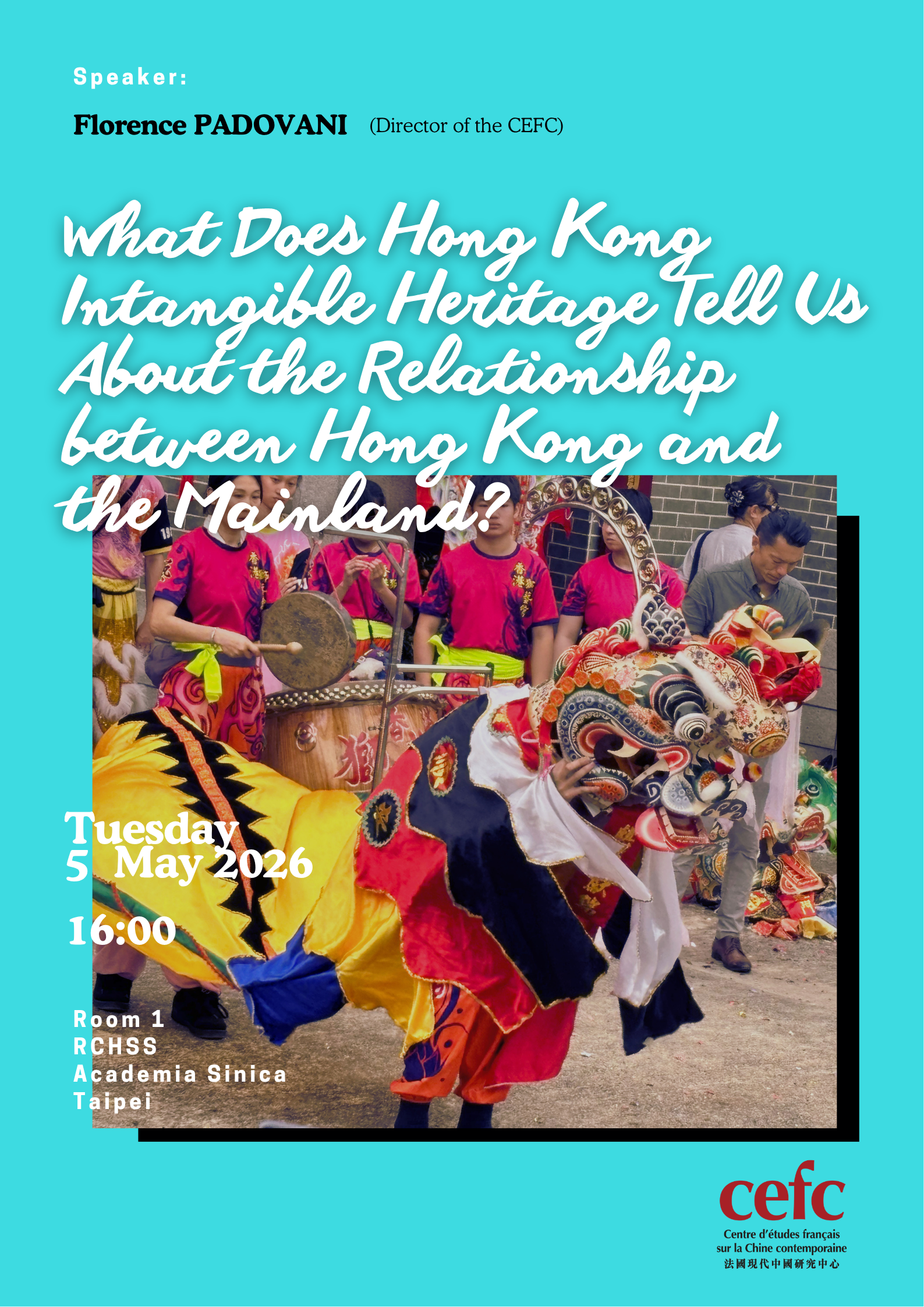
In Hong Kong, as in mainland China, collective memory is primarily mediated through official narratives. The narrative of Hong Kong’s past is especially sensitive, and the recent history museum exhibit is a clear example of a top‑down construction as an official story. While some scholars use a discursive approach to analyze such processes, this presentation focuses instead on living cultural heritage in contemporary Hong Kong, using primaraily fieldworks in Hong Kong New Territories.
Using the Hakka unicorn dance as a case study, I adopt a bottom‑up analysis to examine how memory and tradition are transmitted, and how communities adapt their practices for new uses. This process is closely tied to struggles for recognition and the construction of emerging identities.
Speaker: Florence PADOVANI (Director of the CEFC)
Florence PADOVANI is currently the Director of the CEFC (French Centre for Research on Contemporary China 法國現代中國研究中心). She has been doing intensive research in Mainland China and Hong Kong for a couple of decades. Her main research themes are: Intangible cultural heritage in Hong Kong and Mainland, Internal migrations, the social impacts of Shanghai and Xi’an urban developments and the social impacts of the Three Gorges Dam.
