
Recent years have seen scholars turning their attention to the increased use of digital technologies to coordinate migratory (and tourism) flows. At the heart of these enhancements is a quest for even greater speed at airports, and a desire to unlock newfound capabilities in Big Data. At present, a panoply of post-pandemic solutions exist, ranging from app-based applications, to QR code-mediated border crossings, to token-less travel. This talk will sketch out the logics of these various innovations, and consider their downstream implications on migrants. In particular, international borders now implicitly enlist the work of crossers to prove their regularity by surrendering more and more intimate (or sometimes suggestive) information about themselves. The outcome is a splintering of groups by convenience through these self-sorting procedures, both leaning on old divisions of race, nationality and purpose of travel, and also enrolling the help of migrants to stoke the imagination of their own (in)security.
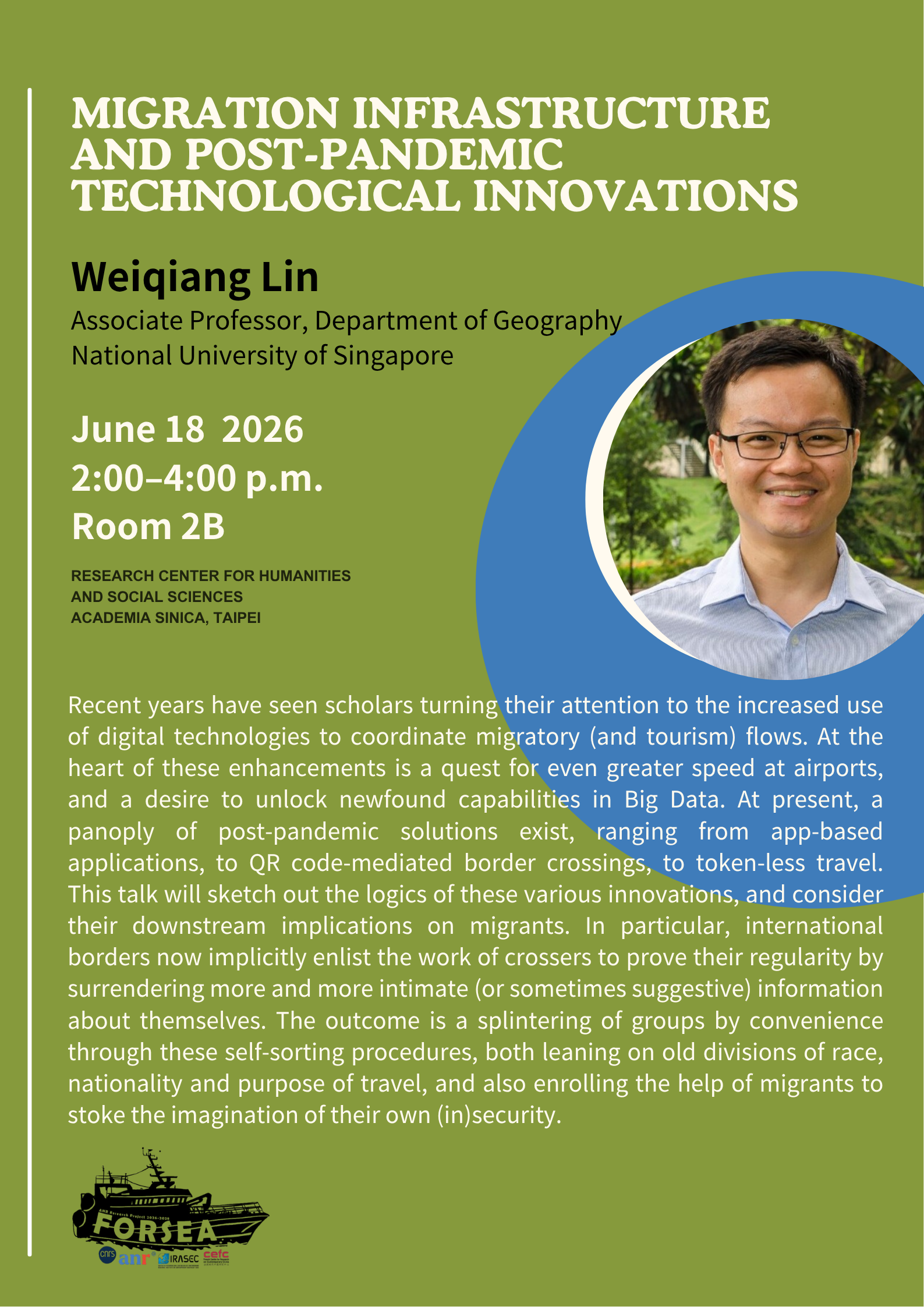
Speaker:Weiqiang Lin (Department of Geography, National University of Singapore)
Weiqiang Lin is Associate Professor at the Department of Geography, National University of Singapore. Trained as a socio-cultural geographer, his research interests revolve around issues of mobilities and the infrastructures of moving. He has over ten years of experience researching on contemporary mobility issues, including in migration and transport. Weiqiang sits on the editorial boards of Dialogues in Human Geography, Digital Geography & Society, Journal of Transport Geography, Mobilities, and Mobility Humanities (also Advisory Board), and is a Section Editor for Transfers (Ideas in Motion). He is currently working on a personal monograph titled Atmospheric Labor with the Temple University Press.