
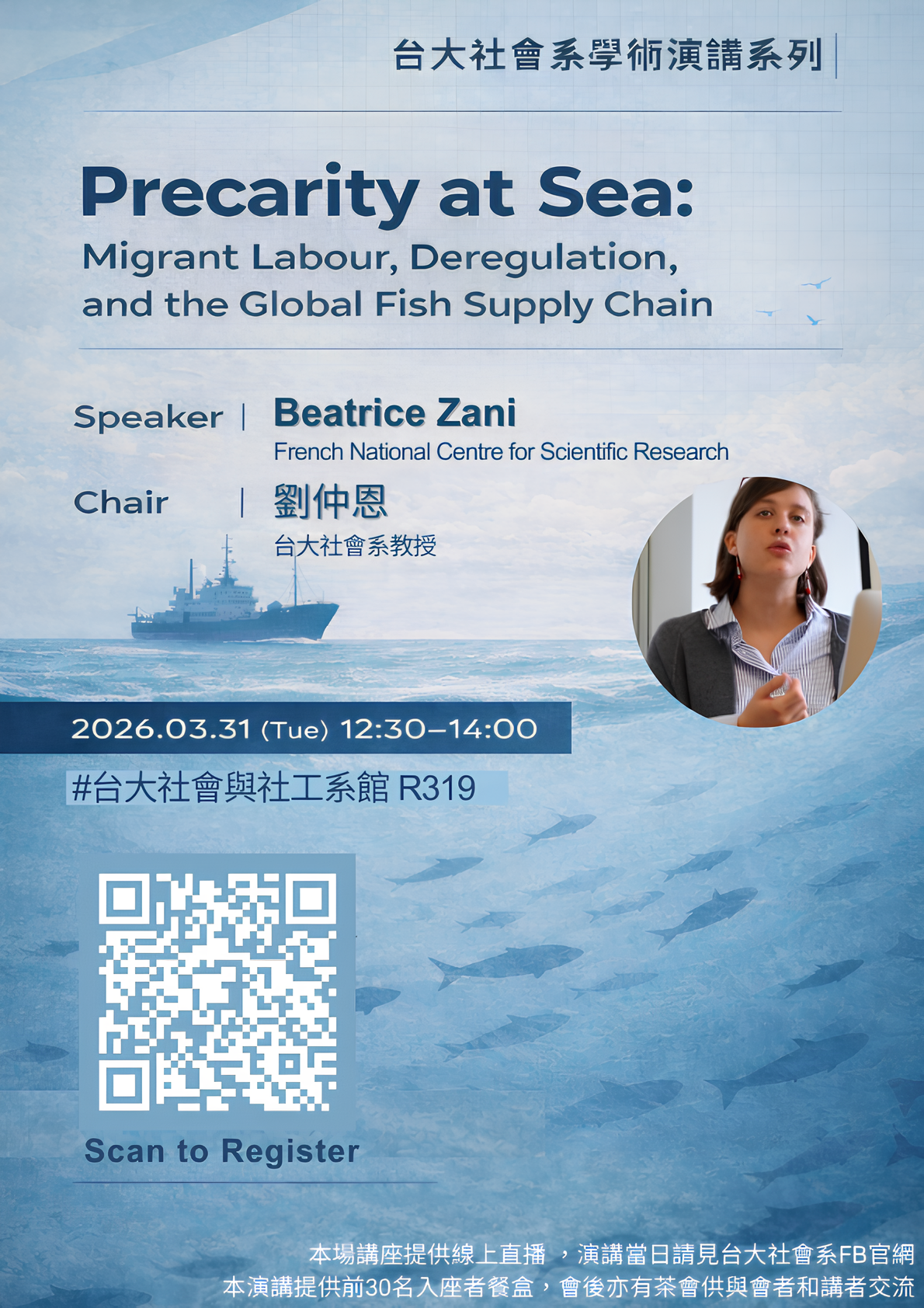
IIn this lecture, I examine the globalized labor regime of the fish supply chain through the experiences of Southeast Asian migrant workers on foreign-flagged fishing vessels. Based on ethnographic research in Taiwan, Singapore, and Indonesia, I explore how labor emerges within and reinforces overlapping ‘gray zones’ of circulation, work, and deregulation. These ambiguous spaces facilitate exploitative conditions marked by racialized hierarchies, mobility restrictions, and socio-economic inequalities. While employers and recruiters exploit these regulatory gaps to maximize profits and control labor, migrant workers also navigate and reshape these structures to secure limited socio-economic opportunities. I situate these findings within debates on labor precarity and global supply chains, extending Kimberly Hoang’s Spiderweb Capitalism to show how the fish supply chain operates through informal practices and regulatory loopholes. I argue that these globalized labor regimes blur the boundaries between legality and illegality, formality and informality, creating precarious and shifting workspaces in contemporary Asian capitalism.
Speakers
Beatrice Zani is a sociologist and an ethnographer, permanent researcher at French National Center for Scientific Research (CNRS)/ French Center for Research on Contemporary China (CEFC Taipei). Drawing on the case study of transnational labor in the Asian fishing and shipping sectors (China, Taiwan, Singapore, Indonesia), her ongoing research explores the link between labor and commodity mobilities, global work and supply chains, informality and digitality in the transformation of capitalism and globalization. She’s the PI of the French National Research Agency (ANR)-funded project FORSEA : Migrations and Forced Labor in the Maritime Economies of Globalized Asia (2026-2028).
Register now:
